
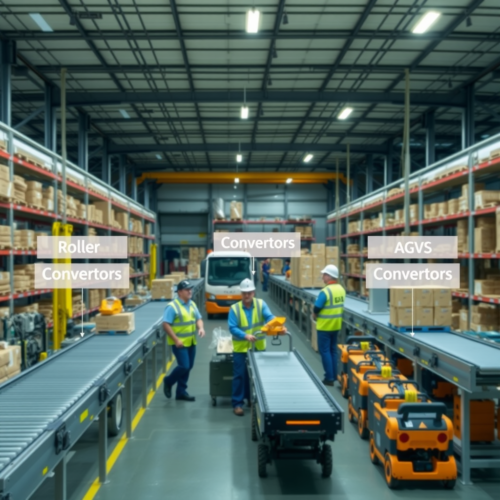
In the modern warehouse setting, efficiency, productivity, and safety are paramount. Conveyor systems have revolutionised the way goods are moved and handled, making operations smoother and more straightforward. Choosing the right type of conveyor can significantly impact your workflow and bottom line. In this article, we delve into the top five conveyor systems every warehouse should consider to enhance their logistics operations.
The Versatility of Belt Conveyors
Belt conveyors are perhaps the most ubiquitous type of conveyor system in use today. Their fundamental design involves a continuous loop of material that moves over pulleys. This simplicity does not diminish their versatility; belt conveyors can be adapted to a myriad of warehouse applications. They are excellent for transporting a variety of goods, from packaged products to bulk materials.
One of the standout advantages of belt conveyors is their ability to handle heavy loads. The sturdy construction allows for transporting bulky and heavy products over considerable distances. They are also easy to maintain and can be integrated with other systems, such as loading docks and sorting equipment. For warehouses looking to optimise their product flow, belt conveyors are often an essential component.
Efficient Roller Conveyors
Roller conveyors offer another efficient solution for material handling in warehouses. Operating on the principle of gravity or powered motion, roller conveyors consist of a series of rollers angled downwards to facilitate movement. These systems are particularly advantageous for transporting items that are stable, such as boxes or pallets.
One notable feature of roller conveyors is their adaptability to various load sizes and weights. They can be configured to handle lightweight parcels as well as heavier goods, greatly enhancing their logistical capabilities. Additionally, roller conveyors can be easily customised with features like sorting capabilities, which can improve the overall efficiency of the shipping and receiving process in a warehouse environment.
The Compactness of Modular Conveyors
For warehouses that value space-saving solutions, modular conveyor systems are an ideal choice. These conveyors can be tailored to fit unique layouts, allowing for maximum utilisation of warehouse space. Modular conveyors are composed of standardised blocks that can be assembled in various configurations to meet specific needs.
One of the significant benefits of modular conveyors is their modularity. Should operational needs change, these systems can be reconfigured or expanded without requiring a complete overhaul. This flexibility allows warehouses to respond swiftly to changing demands, making modular conveyor systems a smart investment for long-term efficiency. Furthermore, they are often equipped with features that enhance their functionality, such as sensor integration for automated control.
Automated Guided Vehicles (AGVs)
As technology continues to evolve, so too do the systems driving warehouse automation. Automated Guided Vehicles (AGVs) represent a cutting-edge solution for material handling. These mobile robots are designed to transport goods from one location to another without direct human intervention.
AGVs can operate independently or collaboratively with other machinery, such as conveyor systems. They are equipped with advanced navigation systems that allow them to manoeuvre through complex environments, avoiding obstacles along the way. In a warehouse setting, this translates to improved efficiency and reduced labour costs, as AGVs can perform repetitive tasks without fatigue.
The integration of AGVs with traditional conveyor systems can create highly efficient workflows, allowing for a seamless transfer of goods between various stages of processing and packing. The increased automation not only enhances productivity but also contributes to a safer working environment by reducing the likelihood of accidents related to human error.
The Precision of Overhead Conveyors
Overhead conveyor systems represent another innovative approach to material handling that can optimise warehouse operations. These systems utilise a network of tracks installed above the warehouse floor, allowing items to be transported in a three-dimensional space. Overhead conveyors are particularly useful for facilities with limited floor space or for transporting items that need to be kept off the ground.
One of the primary benefits of overhead conveyor systems is their ability to free up valuable floor space. With goods moving above head, there is more room for other operations, such as packaging or sorting. Overhead systems can also improve workflow by providing a direct path for goods to move through various stages of processing without interruption.
These systems are commonly used in industries where handling delicate or high-value items is crucial, such as automotive manufacturing or electronics assembly. The precision engineering of overhead conveyors ensures that items are transported safely and securely, minimising the risk of damage.
In conclusion, the selection of the right conveyor system is crucial for optimising operations in any warehouse. By considering the unique requirements and demands of your warehouse, you can choose a conveyor that not only enhances productivity but also supports a safer and more efficient working environment. Whether it’s the versatility of belt conveyors, the adaptability of roller conveyors, or the innovation of AGVs, there is a range of solutions available to meet your operational needs.
Conveyors play a crucial role in modern manufacturing and logistics. These systems efficiently transport materials, streamlining operations. For reliable conveyor solutions, visit https://conveyorrollers.co.uk to explore high-quality options that enhance productivity and minimize downtime.