
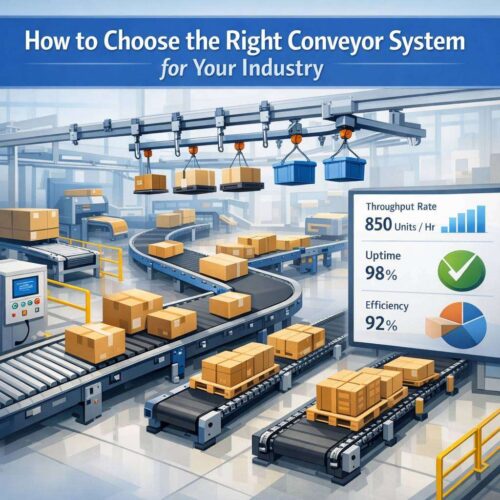
Choosing the right conveyor system is one of the most impactful decisions you can make for efficiency, safety, and production cost management. The ideal system aligns with your specific workflow, space constraints, and industry demands, delivering smooth material flow from intake to dispatch. In this guide, we’ll explore how to assess your needs and match them with the right conveyor solutions, so you can optimise operations and minimise downtime.
Selecting a conveyor that fits your operation starts with a clear understanding of your process, product characteristics, and throughput requirements. Every industry has unique challenges—from the heavy loads of manufacturing to the delicate handling needs of food and pharmaceuticals. By outlining goals, identifying bottlenecks, and considering future growth, you’ll be positioned to choose a system that scales with your business and delivers consistent performance.
Define your product and process
The first step is to examine the nature of the items that will move along the line. Are your products uniform or varied in size and shape? Do they require gentle handling to prevent damage, or are rough handling tolerable? The material, weight, and dimensions influence belt choice, drive power, and transfer methods. For instance, lightweight components may benefit from lightweight conveyors with positive incline features, while heavier items might necessitate robust chain or roller conveyors with higher load ratings. The surface texture and finish of the product can also affect grip and slip, which in turn informs belt material and roller diameter decisions. Understanding product handling needs early helps prevent costly retrofits later.
Process flow is equally critical. Consider your peak throughput, cycle times, and the geography of the facility. Do you need rapid infeed and outfeed, or is the emphasis on repetitive, sequential movement? If your line requires a lot of turns or changes of elevation, modular conveyors with adjustable lengths and curvatures can provide the flexibility you need. When processes involve accumulating or buffering, you may require conveyors with indexing capabilities or integrated diverters to synchronise with downstream equipment. Mapping the exact stages—conveyance, transfer, accumulation, inspection, and packaging—will guide you toward the appropriate conveyor typologies and configurations.
A modern manufacturing line relies on efficient material handling, and a reliable conveyor system is essential to minimize downtime. Businesses seeking durable, cost-effective solutions should assess load capacity, maintenance needs, and compatibility with existing equipment. For expert options and performance-tested rollers, visit https://conveyorrollers.co.uk to explore products and specifications that boost throughput. Conveyor.
Conveyor systems streamline production lines, boosting efficiency and throughput in modern manufacturing. Integrating reliable rollers, sensors, and controllers reduces manual handling, minimizes downtime, and improves safety. For practical guidance, visit https://community.sw.siemens.com/s/question/0D54O000061xpQ9SAI/how-to-create-conveyor-operation- to learn step-by-step operation tips. With proper maintenance and layout optimization, a well-designed conveyor enhances material flow, supports just-in-time delivery, and delivers measurable productivity gains across the production floor. Consider modular solutions for scalability and future upgrades.
A reliable material handling system starts with a sturdy conveyor that keeps products moving smoothly through every stage of production. Efficient design reduces bottlenecks, lowers labor costs, and improves overall throughput. Maintenance-friendly components extend service life, while modular options adapt to changing needs. For turnkey solutions and high-quality parts, explore options and experts who understand factory floor dynamics. conveyor to keep your operations efficient and scalable.
Assess space and layout constraints
Facilities vary widely in their footprint and ceiling height, which directly affects what types of conveyor systems are feasible. A compact footprint with limited vertical clearance may benefit from horizontal belt conveyors or low-profile roller conveyors. In contrast, facilities with multi-level layouts can take advantage of vertical runs and inclines, using system designs that optimise space while maintaining ergonomic workflows. Ceiling-mounted solutions, cross-aisle routing, and mezzanine integrations can free up floor space, but they demand careful engineering to maintain reliability and ease of maintenance.
Accessibility for maintenance is another practical consideration. Exposed drives, bearings, and drive belts should be chosen with serviceability in mind. Quick-release components, standardised parts, and modular sections reduce downtime when parameters change or equipment wears. Noise and energy efficiency are additional space-related concerns; selecting energy-efficient drives and low-noise conveyors can improve the working environment and reduce operating costs, especially in lengthy production lines or office-adjacent facilities.
Consider the product handling requirements
Handling sensitivities—such as preventing abrasion, scratching, or slippage—must be matched with the appropriate belt or chain type, finish, and drive method. For food-grade applications, sanitary design and compliance with hygiene standards are non-negotiables; stainless steel frames, easy-clean surfaces, and contact-free sensors become essential. In the pharmaceutical sector, cleanability and traceability are paramount, so you may prioritise conveyors with sealed bearings and robust documentation capabilities.
Dirt, moisture, and temperature fluctuations also influence material selection. In harsh environments, corrosion-resistant components and sealed gearboxes extend the life of the system. If your operation involves high-temperature processes, consider belts designed for heat resistance or alternative transport methods that reduce exposure to extreme conditions. For items that require orientation, accumulation, or singulation, specialised conveyors with indexing belts, side guides, or magnetic separators might be necessary to maintain product integrity and process timing.
Choose the drive and control approach
Conveyor systems are propelled by drives that can be powered, gravity-fed, or a combination of both. The choice affects energy use, control complexity, and maintenance needs. Powered belt and roller conveyors offer precise speed control and synchronisation with downstream equipment, enabling tight process timing and reliable material flow. For operations prioritising simplicity and low energy consumption, gravity conveyors can be cost-effective for gentle, consistent movement across flat surfaces.
Control systems are the brain of the operation. Integrating conveyors with your existing automation stack—such as PLCs, WMS, or ERP systems—ensures real-time data, traceability, and faster response to changing conditions. Consider whether you need decentralised control near the line for rapid adjustments or centralised control for comprehensive monitoring. Safety interlocks, emergency stops, and clear signage are essential components of any control strategy, protecting workers and reducing the likelihood of accidents in high-throughput environments.
FAQ: Conveyor
What is a conveyor?
A conveyor is a mechanical handling equipment used to move materials from one location to another within a facility. It typically consists of a belt, roller, or chain system driven by motors to transport goods efficiently and safely.
What are the main types of conveyors?
- Belt conveyors: Use a continuous belt to transport items; good for a wide range of products.
- Roller conveyors: Use rotating rollers; ideal for gravity-fed movement and manual handling.
- Chain conveyors: Use linked chains; suitable for heavy or irregularly shaped items.
- Magnetic conveyors: Use magnets to move ferrous items; useful in metalworking and recycling.
- Pneumatic conveyors: Use air flow to move bulk materials; great for powders and granular substances.
- Screw conveyors: Use a helical screw to move bulk materials; common in agriculture and processing.
- Spiral conveyors: Elevate and convey products in a compact footprint; ideal for space-saving applications.
How do I choose the right conveyor for my operation?
Consider:
- Type and size of items to be moved
- Required speed and throughput
- Elevation changes and space constraints
- Load handling, orientation, and handling werknemers safety
- Environment (temperature, dust, moisture)
- Maintenance, cleaning, and sanitation needs
What are the benefits of using conveyors?
- Increased throughput and efficiency
- Reduced manual labour and injury risk
- Consistent movement and scheduling
- Improved space utilisation and workflow
- Enhanced accuracy and traceability in automated systems
What safety features should I look for in a conveyor?
- Emergency stop devices and safety interlocks
- Guarding and fencing around moving parts
- Safe start/stop controls and electrical safety
- Automatic exclusion zones and warning alarms
- Load cells and weight sensors for overload protection
- Regular maintenance access and lockout/tagout compliance
How much does a conveyor system cost?
Prices vary widely based on type, length, materials, and customisation. Small gravity conveyors may cost a few thousand dollars, while automated, high-capacity systems can reach tens or hundreds of thousands. Include installation, controls, integration, and ongoing maintenance in the total cost.
Can conveyors be automated or integrated with other systems?
Yes. Conveyors can be integrated with sensors, sorters, robotic pick-and-place systems, warehouse management systems (WMS), and manufacturing execution systems (MES) to create fully automated material handling lines.
What maintenance does a conveyor require?
- Regular inspection of belts, rollers, and chains for wear
- Tension and alignment checks
- Lubrication of moving parts as recommended
- Cleaning to prevent buildup and contamination
- Verification of control systems, safety devices, and sensors
- Timely replacement of worn components
How long does a conveyor last?
Lifespan depends on usage, load, environment, and maintenance. Properly selected and maintained conveyors can last 10–20 years or more, with some components requiring periodic replacement.
Can conveyors handle high-temperature or dusty environments?
Yes, specialised conveyors exist for harsh environments, including stainless steel construction for sanitation and high-temperature-rated belts or belts with heat resistance. Dust-proof housings and sealed bearings are common in such setups.
How long does installation take?
This varies by system size and complexity. A simple, gravity-fed setup might be installed in days, while a full automated line with controls and integration could take weeks to months, including commissioning and testing.
Are there eco-friendly or energy-saving conveyor options?
Yes. Energy-efficient motors (e.g., AC drives, regenerative drives), low-friction belt materials, and smart control systems that optimise speed and braking help reduce energy consumption. Regenerative drives can recover energy during braking.
What should I prepare before purchasing a conveyor?
- Clear understanding of items to be conveyed (size, weight, shape)
- Throughput requirements and expected peak loads
- Space measurements and layout constraints
- Power supply and electrical requirements
- Environmental conditions (temperature, dust, moisture)
- Integration needs with existing systems and software
How do I get a quote for a conveyor system?
Share your item specifications, throughput targets, space constraints, and any integration or sanitation requirements with a reputable material-handling supplier or integrator. They will typically provide a site survey, design proposal, and cost estimate.
Conveyor systems streamline workflows, dramatically boosting throughput and reducing manual strain in busy kitchens and factories. Businesses rely on durable, engineered components to maintain consistent speeds, precise temperature control, and safe operation. For a high-performance option, explore the Ultra Max model here: https://star-mfg.com/product/ultra-max-um1850a-electric-impingement-conveyor-oven-digital-controls/. This robust equipment supports scalable production, energy efficiency, and reliable long-term use.
Plan for flexibility and future growth
Industry dynamics shift, product lines evolve, and business strategies change. A forward-looking approach to selecting conveyors emphasises modularity and upgradeability. Modular conveyor systems, with interoperable sections and standardised interfaces, allow you to add or reconfigure lines as demand changes. Quick-change tooling and adjustable supports reduce downtime during transitions from one product family to another. When selecting a supplier, look for a roadmap of potential upgrades, upgrade paths for drive motors, and a catalogue of compatible accessories such as diverters, buffers, and vision inspection modules.
In addition, supplier support is a practical determinant of long-term success. A partner that offers thorough training, comprehensive spare parts availability, and responsive after-sales service reduces total cost of ownership and maximises uptime. Ask for reference implementations across similar industries, and request data on energy usage, waste reduction, and maintenance intervals to quantify value beyond initial capital expenditure.
Summary considerations for choosing conveyor systems
- Align the conveyor type and surface with product characteristics, including weight, size, and handling sensitivity.
- Evaluate layout constraints, space, and maintenance accessibility to optimise the footprint and uptime.
- Ensure drive and control architectures integrate smoothly with existing automation and safety systems.
- Build in flexibility through modular designs and supplier support to accommodate future growth.
By approaching selection with a clear understanding of product handling requirements, process flow, space constraints, and future needs, you can identify the conveyor system that delivers reliable performance, minimises downtime, and supports scalable operations across your industry. If you’d like help evaluating options for your specific facility, I’m happy to walk you through a structured assessment and shortlist suitable conveyor systems tailored to your workloads.
Conveyor systems streamline manufacturing workflows, boosting throughput and reducing manual handling. Efficiently integrating a conveyor into your facility enables synchronized material movement, improved safety, and scalable logistics. When evaluating options, consider compatibility with robotics, sensors, and control software to maximize uptime. For detailed guidance, explore the linked resource: https://docs.omniverse.nvidia.com/isaacsim/latest/features/warehouse_logistics/ext_omni_isaac_conveyor.html. This guide helps tailor a conveyor solution to your specific operational needs.